By Olivia Borgula | Capital News Service
Every time it rains in Adamstown, Maryland, slick mud covers the road until the painted yellow stripes are no longer visible.
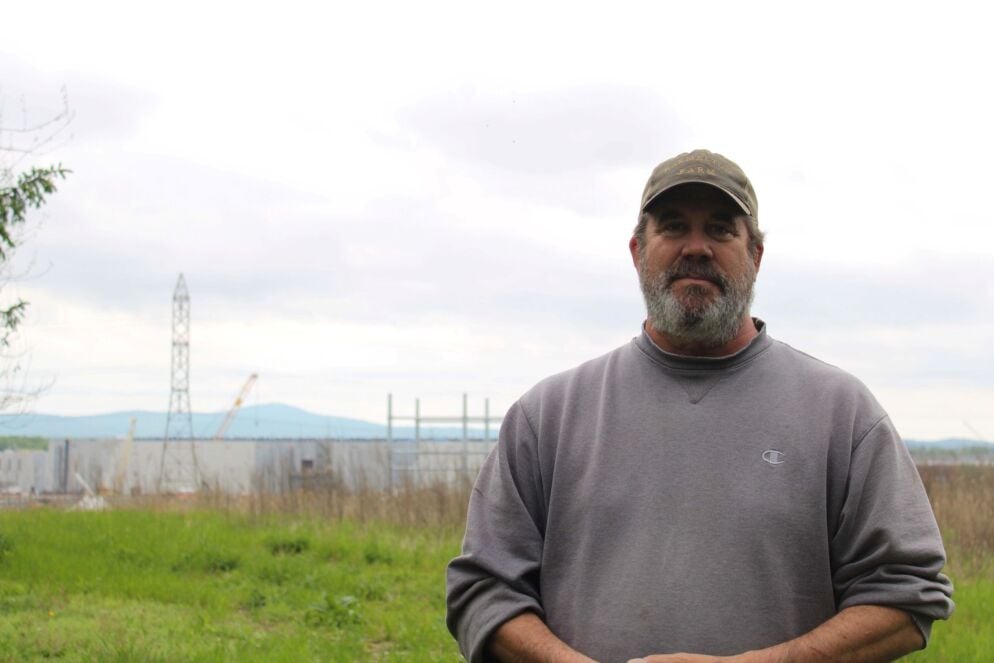
Resident Steve Black worries that mud comes from an abandoned aluminum smelting plant — the site of construction for a massive new “hyperscale” data center.
“How does anybody in the community know that they are or are not tracking contaminated dirt out onto the roads?” Black asked.
Frederick has more planned hyperscale data centers than any other county in Maryland, according to an industry-created dataset. These facilities will come online in as early as three years, according to some estimates, prompting local concerns that the area will soon resemble “data center alley” in nearby Loudon County, Virginia.
Local pushback grew in December when the Frederick County Council voted to expand the zone designated for data center development by another 1,000 acres, bringing the area to the equivalent of almost 2,000 football fields. The county introduced this zone to limit data center development to a confined area, one that amounts to less than 1% of the county’s entire landmass.
The site primarily covers Adamstown farmland about nine miles southwest of Frederick City. The Frederick County Data Center Referendum Committee, which Black chairs, is working to add a referendum to the November ballot that would give residents the power to veto the county council’s decision.
Critics cite a range of environmental and health concerns.
“We’re going to have a little bit of money for the county, a lot of money for the data center owners,” said Betty Law, a retired electric power engineer and active member in the referendum committee. “In the meantime, we have lost what was there — this beautiful landscape.”
Environmental concerns
The Eastalco Alcoa Works plant where a data center campus is being constructed in Adamstown once produced 8% of the nation’s aluminum. But the facility closed in 2010 and was later demolished
It’s now designated as a brownfield site, which the Environmental Protection Agency defines as a property with the potential presence of hazardous substances, pollutants or contaminants. The state issued a letter of no further action in 2018, meaning the property owner doesn’t have to do further cleanup, but there are limitations on what can be built at the site, such as residential housing or schools.
About 250 acres of this site has been bought and approved for data center development, causing concerns about the potential for contamination, especially when dust clouds from dried mud and construction sites billow through the air, Black said.
“Construction is an ugly, messy process if you’re building a shopping mall or a house or a house or a data center,” Black said. “But there are rules to minimize the messiness, and this is all made more complicated by the fact that part of the area where construction is going on is a brownfield site with known contamination of the soil.”
The county’s overlay zone also gives the green light for a data center to be built about 900 feet away from an elementary school.
If the power shuts off, massive diesel backup generators will come on to ensure the data center facilities can stay running. Law, who lives in Adamstown, is concerned about the impact of emissions from these generators on children. She has advocated for HEPA filters or other preventative measures.
“There will be hundreds of these diesel generators … when they come on, they will put out pollution and noise,” she said.
Among the other concerns voiced by Frederick residents is data centers’ water use.
A medium-sized data center can consume up to about 110 million gallons of water each year to cool its computer chips and servers, according to the Environmental and Energy Study Institute. That’s about as much water as roughly 1,000 households would use. Larger data centers can consume up to 5 million gallons every day, or the amount of a small town between 10,000 to 50,000 people.
Frederick data center campuses are approved to use just over 1 million gallons a day of water from the municipal water supply during its first phase of buildout, according to a 2024 Frederick County workgroup presentation.
Kevin Sellner, an aquatic ecologist who works for Hood College in Frederick, said data center structures can impact stormwater management because they’re huge, impervious surfaces. He expressed concern about wastewater treatment plants that have to manage salty, brackish water that occurs in some facilities that reuse water to cool corrosive machinery.
“In rural communities, where wastewater treatment facilities are not as advanced as, say, Washington, D.C. or any large city, they may not have sufficient treatment capacity or to essentially remove all those contaminants,” he said, “so you jeopardize the operations of those smaller wastewater treatment facilities and therefore you pose problems to the environment.”
While data centers’ raw water consumption is a fraction of what other industries, such as agriculture and golfing, require, experts say the sudden surge in data centers coming online could harm regions already dealing with water scarcity.
About 46% of Maryland is experiencing extreme drought, including Prince George’s County, Baltimore City and parts of Baltimore County, according to recent data from research organization U.S. Drought Monitor.
“If you have only a few data centers across the globe, then it’s probably not a big deal,” said Ayșe Coskun, a professor at Boston University and chief scientist at Emerald AI. “But as we are building more data centers, if a lot of them are also doing water cooling, they would pull water from fresh water resources and dump that water back somewhere.”
In Maryland, advocates say data centers could impact major water sources like the Potomac River and the Chesapeake Bay.
According to a March report from the Interstate Commission on the Potomac River Basin, the cluster of data centers near the basin, including some from Northern Virginia, account for a small fraction of annual water loss from evaporation in the Washington Metropolitan area.
But managing peak load during the summer could pose a challenge. During the hottest months, water loss due to evaporation, which happens as water is used to cool data centers, can account for up to 12% of the basin’s evaporative water loss.
Anna Mudd, senior director of policy at clean water advocacy organization Potomac Conservatory, said while water quality has improved in the Potomac in recent years, progress is starting to stall.She said she’d like to see more leadership from state elected officials to study the environmental impacts of data centers.
“We’ve gotten all the low hanging fruit. We’ve upgraded storm water infrastructure, we’ve upgraded sewer plants and things like that, but there continues to be a significant amount of development pressure in the D.C. metro area,” Mudd said.
Residents have also expressed concerns about the facilities’ light and noise pollution. Many hyperscale data centers are considered high security facilities, which require large external floodlights at night similar to a prison, according to Black. The hum of machinery – which can in some cases be heard hundreds of feet away – can trigger effects ranging from annoyance to sleep deprivation and cognitive decline.
“The noise is 24/7, and it’s a constant noise,” said David Tilley, an associate professor of environmental science and technology at the University of Maryland. “These frequencies can be really kind of annoying to people, potentially damaging.”
But Kelly Schulz, CEO of the Maryland Tech Council, said data centers can bring benefits to the county, especially as Maryland faces a statewide budget deficit. Frederick County was able to use funds from the purchase of the data center land toward programs that would have been difficult to fund due to budget constraints, including one providing free bus transportation and agricultural preservation funds.
A December 2025 study from real estate consultant HR&A Advisors found that the Frederick data centers will lead to more than 8,000 jobs each year of construction and $215 million in annual tax revenue, which is equal to one fifth of the county’s entire budget.
Schulz added that data centers aren’t a new phenomenon, and pointed to rising demand for non-AI computer needs.
“Although this seems like it’s a really new phenomenon that Maryland could get some additional data centers, they’re not the first data centers to show up, but they are being more highly regulated now than they ever have been in the past,” she said. “We’ve already had data centers in the past that have operated without issues in communities around the state.”
Local pushback
In January, when a foot and a half of snow and ice coated the ground, volunteers for the referendum committee set out to get at least 15,000 signatures on their petition to stop the data center zoning expansion. They had 60 days.
Volunteers sometimes went door to door, but mainly set up in coffee shops and other areas of the community, where they explained their opposition to the expansion and why residents should sign the petition.
By March, they got just over 21,000 approved signatures — about 10% of registered voters in Frederick.
Five legal challenges were filed after the county Board of Elections approved the referendum signatures, mainly from entities that own properties near the data center zone. The petitioners argued that the ordinance that created the zone is not subject to a referendum.
“Four of the five companies are not even based in Frederick County. Three of them are out of state, mega corporations that are suing [21,000] Frederick voters essentially to say: ‘The thing you want to say on, you don’t get to have a say. We will do in your county what we want,’” Black said.
Data centers were once hailed by government leaders and policymakers as technological advances. But as public opinion on them began to sour, local opposition caused jurisdictions in Maryland and around the country to reconsider development.
Between March 2024 and March 2025, $64 billion in data center projects were blocked or delayed, according to Data Center Watch. And according to a Washington Post-Schar School poll released last week, just 35% of Virginia residents said they’d feel comfortable if a data center was built in their community — down from 69% three years ago.
A six-hour long mid-December Frederick County Council meeting stretched into the early hours of the morning after more than 70 speakers came to voice their opinions on the expansion of the data center zone. About 70% of them advocated in opposition to the plan, according to reporting from the Frederick News-Post.
Christian Benford, a candidate for Frederick County Council, was one of the people who spoke at the meeting. He said in an interview that the county government should do a better job listening to residents and implement more guardrails, such as an environmental escrow fund. If he’s elected, he said he wouldn’t approve further water usage and would advocate for data centers to generate their own energy.
“If the county council did a good enough job of listening to constituent concerns, we wouldn’t have had the expansion of the overlay zone in the first place,” Benford said. “Billionaire companies that are promising, you know, X amount of revenue to localities, but it’s residents that are really footing the bill.”
This story was originally published for Capital News Service.

Author: Guest Post
Frederick's Child is written by parents like you. Want to contribute? Send a story pitch or personal essay to editor@frederickschild.com.